
OUTSIDE THE BOX || APRIL 2026
Welcome to April’s edition of Outside the Box. In this newsletter we share updates, tips, and opportunities from our employment programme.
Dinner and Auction Fundraiser
It’s safe to say our fundraiser was a resounding success! It was fantastic to see so many of our supporters and employer partners in one room, celebrating what we’ve achieved together so far while raising funds for the work still to come.
We were thrilled to raise over $100,000 to support our employment programme. This funding enables us to provide tailored, ongoing support to our graduates as they transition into the workforce. We work alongside them to navigate workplace dynamics, build confidence, and strengthen key skills such as teamwork, time management, and communication. Graduates also have opportunities to visit different workplaces, explore their values, and shape meaningful career goals.
The programme also supports employers. Thanks to our generous donors, we can provide on-site job coaching during the early stages of employment and deliver practical workshops that help teams build more inclusive, supportive workplace cultures.
If you’d like to know more about the details of our programme and everything we offer, please reach out. We are happy to share!
Graduate News
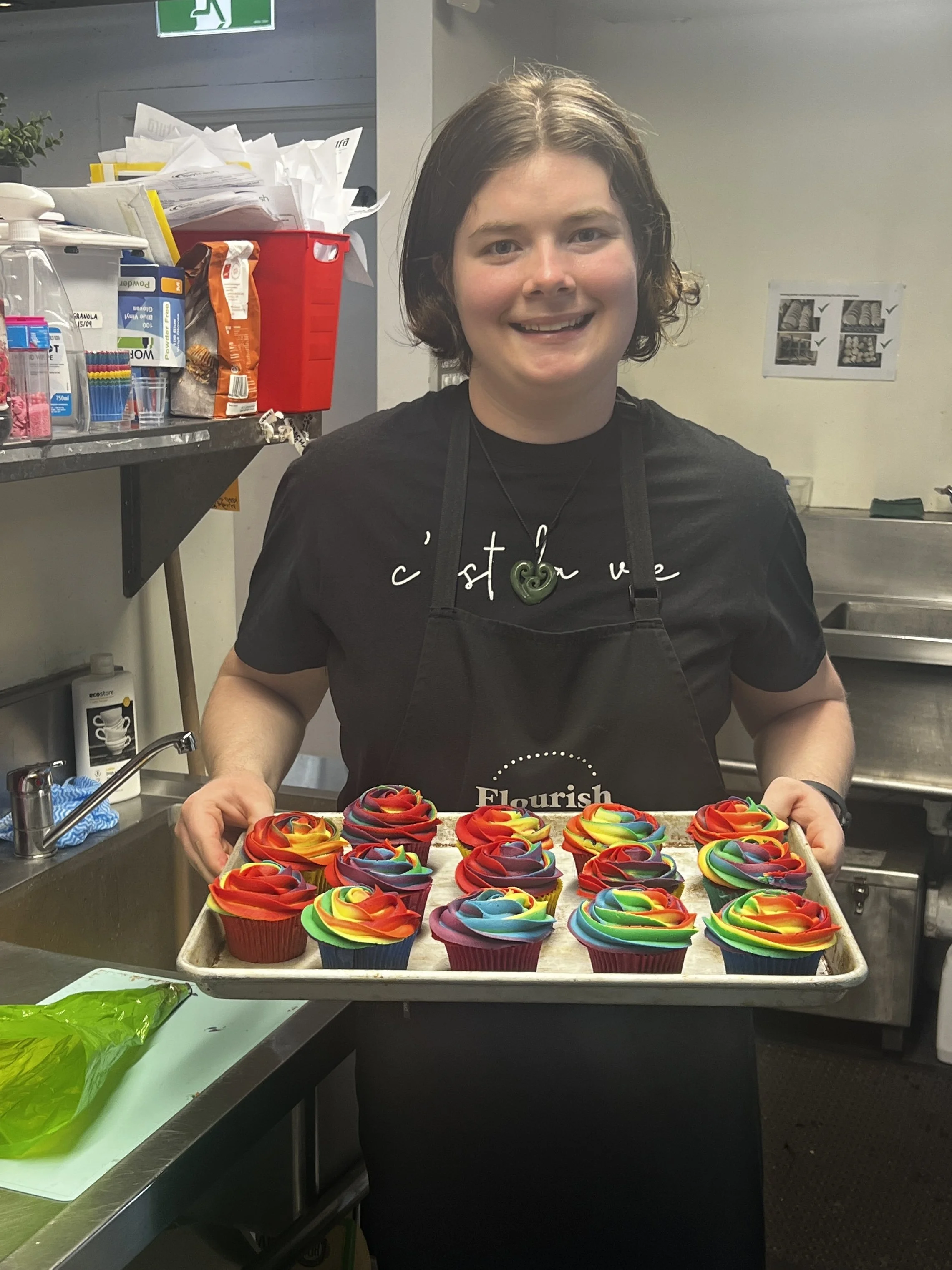
Our graduate, now food preparation assistant, Danika is behind many of the tasty treats at Flourish — her recent gingerbread Easter cookies were a real customer favourite.
To help Danika keep building her skills and confidence, the afternoon tea team at the Hilton have taken her under their wing. Danika also spoke on stage at our fundraiser and shared that she still can’t quite believe she’s learning at the Hilton!
We’ve seen Danika grow so much since she first joined us as a trainee at the beginning of last year. We’re really excited to see what lies ahead for her and to keep supporting her on this journey.
Tips for Neurodivergent Inclusion
What is does neuro-affirming mean in a workplace?
A neuro-affirming approach means recognising that different brains work in different ways, and that these differences are a normal part of human diversity.
Rather than focusing on “fixing” people, it focuses on creating environments where people can do their best work. In practice, this means asking what support, structure, or flexibility might help someone succeed, rather than assuming they are not trying hard enough.
It might look like clearer expectations, more predictable routines, practical reminders, or flexible approaches to time and task management.
Here’s an example of a neuro-affirming approach to time blindness.
But first - what is time blindness?
Time blindness is something we sometimes see in neurodivergent people, particularly those with ADHD and sometimes Autism. It describes difficulty accurately sensing, tracking, or planning around time.
It’s not about effort or attitude — it’s about how the brain processes time. Minutes can feel much shorter or longer than they actually are, future deadlines don’t always feel real until they become urgent, and transitions between tasks (getting ready, commuting, starting work) can easily get lost along the way.
We also know this can be made worse by stress or pressure. When someone is rushed or anxious, time can feel even harder to track, planning becomes more difficult, and transitions are more likely to fall apart. This can create a frustrating cycle where lateness leads to stress, and stress then increases the likelihood of lateness. People who struggle with time blindness often feel ashamed. But in truth it’s just that society and most workplaces are not designed for neurodivergent brains.
Employer tips:
Assume difference, not disregard
Time blindness is an executive functioning difference, not a lack of care or motivation.Make time visible, not abstract
Use visible, colourful wall calendars, reminders, timers, and shared schedules. Don’t rely on internal tracking alone.Be specific about expectations
Replace “be on time” with clear definitions like “ready to start at 9:00am, logged in and set up.”Support transitions, not just arrival times
Most lateness happens before work begins. Help structure leaving, commuting, and start-of-day routines.Build in buffers where possible
Even small flexibility around start times can reduce pressure and improve consistency.Offer reminders for when to start AND switch tasks
Time blindness often shows up in transitions, not just punctuality.Start with curiosity
“What part of mornings is hardest?” will get you further than repeated warnings.Design systems, not just expectations
The goal isn’t to push people harder — it’s to make success easier and more repeatable.Keep standards high, but remove unnecessary barriers
Accountability and support aren’t opposites — they work best together.
Graduates Seeking Employment
Caleb 🌟
Caleb says his top three values are kindness, reliability and teamwork. He’s social and loves to work as part of a team.
Caleb likes the idea of working outdoors or possibly something with animals. He doesn’t mind getting his hands dirty!
In his spare time, he’s a big music fan and he really likes to get out into nature.
Juan 🌟
Juan’s top three values are positivity, learning new things and teamwork. This really reflects his upbeat, helpful personality.
He’s a creative guy who enjoys acting, poetry, music and dancing. He would love to work somewhere nice and calm with a great community vibe. He’s also up for outdoor work and says he’s really fit!
Worth Sharing
We’re proud to share our collaboration with Whaikaha – Ministry of Disabled People, contributing to their new website which aims to boost employment opportunities for disabled people. The site is packed with useful tips for employers and is growing every day. Check it out here: One in Six